Tag: Leadership

  • To win long term you need to invest in the human

    To win long term you need to invest in the human

    Intended audience: leaders looking to win at the long game in a world that changes faster than many can adapt.

    Note that AI was used to research workforce trends and latest statistics but the qualitative examples, analysis, and conclusions are my own.

    I had an interesting conversation the other day about the future of creative work. The young man challenges his LinkedIn audience to think what would make someone stand out if everyone has the same access to the same AI tools. There were many comments praising human qualities and human creativity. However, this discourse pointed at a deeply flawed way we think about the nature of work, AI, creativity, and being human in an increasingly automated world.

    It’s not “we have access to the same AI tools…” It’s “we have access to the same tools.” Just tools. Not AI. Full stop. This thought is older than AI. What made someone a resilient, creative, enthusiastic professional hasn’t changed. I’m worried that by chasing the next big thing many leaders forget, or set aside, something that we knew for a long time already.

    Trillions for tools, pennies for people.

    Don’t take my word for it. Here are some hard stats to support my thesis:

    • 74% report increased IT & Software investment yet many still rely on manual, disconnected processes that create false sense of control until real-world demands expose the gaps [1][2]
    • Department of Education shows that British employers reduced their investment in staff training by £6bn in 2024, compared to 2022 levels [3] yet UK business investment in AI is due to raise by 40% [4]
    • While the industry celebrates AI’s potential to “unleash creativity” the reality on the ground is one of increasing “technostress” and “change exhaustion” [5]

    It used to be that businesses invested in people. Now businesses invest in AI. The declines in training expenditure is particularly alarming given the pace of technological change and raising complexity of work. The result is a workforce that is being asked to do more with complex tools but with less institutional support for learning how to use them safely and strategically.

    This led to the raise of “Shadow AI”, where employees, eager to be productive but left untrained, use unapproved AI tools at work. In the UK, 68% report that staff use shadow AI tools, which already led to data or IP exposure in 44% of businesses [6]. This phenomenon is the ultimate evidence of my hypothesis that businesses are forgetting to invest in people.

    Signals that businesses are investing in humans again

    There are tentative signals out there that people investment is on the rebound.

    McKinsey Forward programme has a strong focus on adaptability, effective communication, relationship building, problem-solving, and digital and AI essentials. Notice how digital and AI essentials are at the bottom of the list.

    Deloitte US released a report called “In a new era of work, winning organisations will build the human advantage,” that outlines the importance of building adaptability, resilience, and creativity. Those human skills. It’s funny that this report is dated 4 March and I’m writing this blog 10 days later. Great minds think alike!

    IBM SkillsBuild is committed to training 2 million people in AI by the end of 2026. The program focuses on “essential workplace skills”, critical thinking, and integrity.

    Lloyds Banking Group surveyed 1,200 UK companies and found that more firms are planning to invest in their staff (35%) than in AI technology itself (33%) in 2026.

    Why is this important?

    As a future designer I’m paid to think about long horizons. As a human-centred AI advocate I’m loving the shift towards investing in humans. As a service designer I want to design services that will support me in my old age. As a design leader sometimes tasked with building design capability and design thinking withing organisations, I sometimes want to scream:

    “What AI? What adoption roadmap? Sweep your house first! You have managers who don’t know how to be managers! You have people that lack basic skills to do their jobs properly! Train them first, then we can talk about AI.”

    It’s important because in a world that changes every five minutes, in a world where everyone has the same tools, the true differentiator will be human creativity.
  • Making design change irresistible

    Making design change irresistible

    Intended audience: design leaders working on increasing design maturity of their organisation and struggling to gain traction. In this article I’m reflecting on the last decade of building design capability and why we still struggle to “get a seat at a table.”

    The theme of increasing design maturity has been following me around my entire career. From the very first UX project all I heard was about proving value and increasing maturity, getting a seat at the table, and making the organisation more customer focused. I spent several years in that role as a junior before leaving to build user research capability at another company. It is then I really came to appreciate “the struggle.” Herding cats, more like.

    Now, a decade on, I’m sometimes heading up design teams. Sometimes I work with the head of design to improve things. It’s interesting that the struggle is still as real in 2026 as it was in 2016. Design is still fighting for its seat at the table. Sometimes it even feels like we’ve gone backwards to pre-2016 understanding of design. I wonder why that is.

    Capitalism? For sure. In a world that incentivises growth and profit it’s hard to make a case for good design. It’s always an investment with dubious returns.

    AI? No. Designers got sidelined well before AI came on scene. In fact, a lot of people on LinkedIn are saying design is going through a bit of a revival.

    We also need to really define what we mean by “design” because if you ask 10 people what they thing design is you will get 10 different answers.

    To be frank, I think the real reason is that everyone is a little tired of design thinking being shoved down their throats. No one comes to work planning to do a bad job. Yet we—and I very much was in that camp many years ago—come in and start shouting, “HUMAN-CENTRED!” from the doorway. This makes people feel bad and we, humans, avoid things that make us feel bad.

    Another factor is that many designers really don’t know how to speak to the business. Google “proving value of design” and you will inevitably find something about calculating ROI and connecting usability metrics to conversion metrics. This is great on one hand, but it doesn’t quite solve the fundamental issue — designers are not business people.

    Making change stick

    I recently listened to an excellent book called Irresistible Change by Phil Gilbert. In it the author talks about his approach to making IBM more customer focused and design lead in 2010s. A programme of transformation is never easy, I’ve seen plenty of failed ones. Reinventing a 400,000 strong global company is a titanic undertaking. Phil, as Head of Design, did something that many fail at and he did it with such grace and finesse that I had to re-listen parts of the book thinking, “this is genius, why didn’t I think of that?!”

    Not everything will be applicable but I loved one of the central ideas of the book, and it is this: change is a product. I never thought about it this way. By applying product design principles to change we can reframe the entire premise. Instead of “how do we prove value” it turns into “how do we make this desirable?” It’s nuanced but it made me think of how I would have done things differently in the past.

    I would stop obsessing over metrics and would focus on the problems design can help solve. When we introduced Google’s Design Sprint at MoneySuperMarket people very quickly saw its value. Making a decision in a week rather than months? Yes please! They got so popular we had to pause them because the team was getting fatigued. I’m sure we documented this benefit back then, but I’m not sure the executives really saw this.

    I would also make design a premium resource. Phil talks about this in his book actually. If you say ‘yes’ to everything, whatever skill you’re bringing gets devalued. Phil had a very specific set of criteria for the projects his team took on. I’d adopt a similar approach. At Truepill we had an intake form but it was designed to give us information about the project. We still took on everything we got asked to do.

    As you can see, treating design as a product opens interesting avenues. How would existing persuasive design principles work in this context? Scarcity? Social proof? Is there anything cool we can do there to make people actually want design on their projects?

    Design as a system

    A little cringe but bear with me. Phil Gilbert made design design thinking into a product and used product principles to make it a success. Why can’t we push this idea further?

    If you’re not familiar with the four orders of design, a quick reminder:

    1. Symbols and communication: how we convey messages, includes things like graphic design, branding, illustration, semiotics, logos, etc.
    2. Things and objects: physical artefacts, focusing on form, function, materials; includes product design, fashion, industrial design, etc.
    3. Actions and interactions: involves experiences, services, and interactions between people; includes UX, service, and interaction design.
    4. Systems and environments: designing complexity, ways of doing, being, and thinking; includes organisation design, policy, architecture, etc.

    What if we think of design as a holistic system of interconnected elements that all rely on each other? Where are our reinforcing feedback loops? Where are the leverage points in our organisation to make change happen?

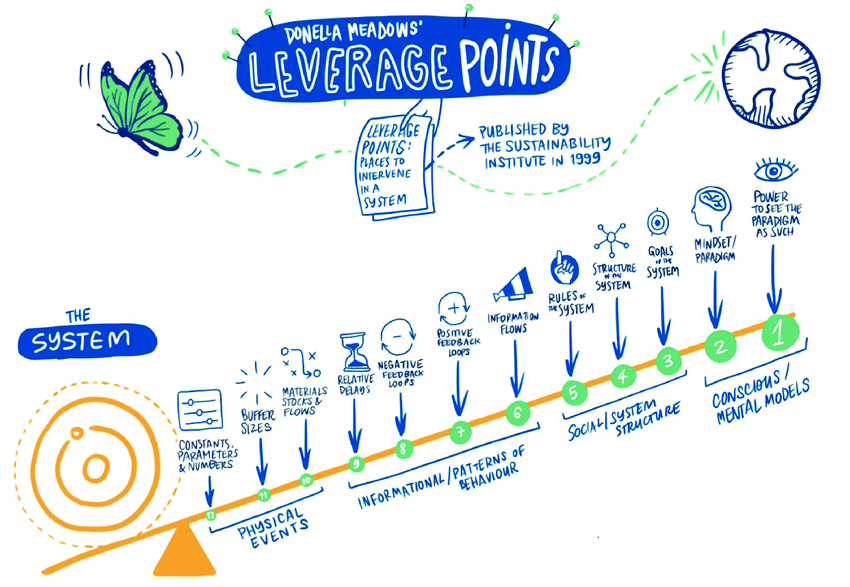
    Leverage points by Donella Meadows is particularly interesting to me. I wish every design change or maturity effort started with this system mapping.

    Donella Meadow’s leverage points by David Ehrlichman

    The idea is that to change the state of the system you need to impact one of those levers. Intervening at the bottom of the diagram (physical events) has little impact and can be potentially hard to do. Intervening at the top (mental models) has huge impact.

    This particular diagram isn’t quite right for design contexts but it gives a good idea. We need to find leverage points worth investing in and stop spending time on things that don’t make impact. ROI comes to mind. It lives squarely in the “constants, parameters & numbers” bucket. I once spend a tremendous amount of effort trying to prove the ROI of research. It has an impact of sorts and I was successful. How much more impact would I have achieved had I invested time in changing mindsets and mental models though.

    It’s an interesting area to explore. Design as a system. What are our leverage points? What are the actors within the organisational ecosystem we could influence? Where are the information flows and positive feedback loops?

  • A B2B Provider Portal

    A B2B Provider Portal

    Note: I’m unable to share original designs for this project due to client confidentiality.

    Situation

    A global healthcare client had the requirement to design and launch a rebate portal quickly. The portal’s functionality was simple: providers upload sales data each month and the client’s finance team processes this data and pays rebates based on the volume of packs, repeat prescriptions, and other factors.

    Task

    I was the lead product designer on the project, working with cross-functional colleagues to design and launch the portal. My responsibility was to manage a small team of designers to turn the client’s ambition into a usable, useful, and accessible solution for providers and back-office administrators to process sales data.

    Action

    • Facilitated multiple visioning and ideation workshops with client leadership to gain alignment and consensus
    • Worked across geographies, collaborating with teams in US and India
    • Created information architecture and service blueprint of the full end-to-end experience
    • Navigated regulatory complexity around user research and created several proto-personas from available data
    • Improved the proto-personas by analysing 17k forum comments with Gen AI, NLTK, and scikit-learn Python libraries
    • Navigated ambiguity while building a high performing culture within the design team
    • Worked cross-functionally with developers and architects, inputting into data architecture, writing Jira tickets, and working with QA to track and prioritise defects

    Result

    The provider portal was launched to the initial pool of users (20 providers) in January 2025 and was soon scaled to the full 20,000 user base. The designers were rolled off the project by then but I heard positive feedback from colleagues close to the project. On top of that I received stellar feedback from the client and my direct reports for reducing ambiguity, using innovative methods to conduct proxy research (in the absence of real research), and for building a great team culture.

  • Central Government Alpha

    Central Government Alpha

    Situation

    The client was amidst a complex digital transformation programme. The ambition was to digitise and modernise by automating manual processes, creating robust data processing capabilities, and re-designing their end-to-end service.

    My responsibilities included supporting the client’s head of research and leading a team of 18 client and Deloitte researchers across 4 streams of work, supporting the wider product leadership, and ensuring the services all built to all relevant standards (GOV Service Standard, WCAG).

    The situation within the team was challenging. Specifically:

    • Immense complexity with 50+ user types identified in Discovery resulting in difficulty prioritising effort
    • Large number of user needs with significant overlap between work streams resulting in duplicated work
    • Demotivated teams with low morale, they’ve been at it for two years and the complexity was only rising
    • Unsuccessful digital transformation efforts in the past left stakeholders and users weary and distrustful
    • The participant pool was drying up with internal stakeholders showing signs of fatigue, and external participants coming back for repeat visits impacting the validity of our findings

    Task

    I supported the client’s head of research to create a unified roadmap of user research, ensure the new service is accessible, ensure high quality and reliability of research to withstand ministerial scrutiny and pass the GOV Service Assessment, and augment and upskill the existing teams with knowledge transfers, training, and mentorship.

    Actions

    Introducing OKRs

    From the initial 1:1s with the team and the subsequent full-team retro we identified 8 areas of improvement that were then synthesised into actionable goals and measurable results.

    Standardising research

    I worked with the Product and Delivery leadership to align research activities to the release roadmap across all work streams. My proposed approach was to work in dual-track Agile with the aim of ensuring both evaluative and generative research is considered.

    I also introduced a standard research checklist, report and kick-off templates, and other collateral to ensure uniformity and high quality of outputs.

    Standardising personas, introducing archetypes

    The client’s 50+ user personas were synthesised into 6 high level archetypes in an attempt to simplify and standardise the programme’s approach. We worked with the brand team to create engaging visuals for each archetype and socialised them widely within the department, even printing out posters and hanging them around the office.

    Addressing participant fatigue

    By introducing research a prioritisation matrix we identified that not every feature needs to be researched in depth. Some features with low ambiguity can be evaluated in a leaner manner reducing the overall strain on the limited participant pool. To address this we began onboarding UserZoom to empower the design team to run their own unmoderated usability tests from templates we’ve set up for them.

    The client already had an internal participant panel and we spent some time reviewing and improving it, as well as running several email interviews to understand how participants felt about being on the panel. We wrote a communications guide for research ops colleagues sending out invites to reflect some of this feedback, e.g., “we know it’s been tough but we need you!”

    Made a significant decision that we will not exclude repeat participants, but instead put a timer on how often they can participate. The timer was initially 6 months but was later changed to 2.

    Centralising insight

    I introduced a central research repository and championed the use of Dovetail. While I supported the Head of Research with internal business case and onboarding efforts, I built a research repository in Excel.

    Each insight was paired with its parent work stream, supported by specific evidence, and had a column for any actions that were made based on this insight. I also introduced monthly grooming meetings where each work stream lead updated their actions for the previous month. This approach significantly increased transparency of research, our ability to cross-reference similar data from different work streams, and our ability to track actions therefore evidencing impact.

    Introducing new methods

    I introduced new methods like:

    • The Kano model to improve prioritisation
    • UX-Lite to measure impact of design
    • Rainbow analysis to make analysis fast, fun, and visual

    Improving Culture

    I ran one off-site for the team where we did team building exercises and got to know each other. This was, according to my end of year written feedback, one of the most fun events to happen on the programme.

    I also introduced standard rituals like frequent retros, manuals of me, regular 1:1s, and ‘fun Fridays’ where we would play skribbl.io and other online games together.

    Result

    It’s hard to measure, but I think the team was much happier when I left, as evidenced by written feedback I received:

    A massive thanks to you Arty for being a great UR but an even better human being. I’d like to think I shared with you quite often the positive impact and useful things you taught me in our time working together. You have been, hands down, the most positively impactful Deloitte UR that joined the team and working with you was great fun. — Senior User Researcher

    Or this one:

    Oh my gosh, what value didn’t you add?? You came to us when we desperately needed an injection of new life, new ideas and refreshed approaches, and you certainly brought that. I know the whole team benefited from your expertise and vigour. — Head of Research

    More objectively however:

    • The teams passed 3 Alpha service assessments, receiving “Green” across the board for research related standards
    • We achieved 80% insight to action rate as evidenced in the central repository
    • We raised UX-Lite by 16 points in 12 months (aggregated across all work streams)