Intended audience: design leaders working on increasing design maturity of their organisation and struggling to gain traction. In this article I’m reflecting on the last decade of building design capability and why we still struggle to “get a seat at a table.”
The theme of increasing design maturity has been following me around my entire career. From the very first UX project all I heard was about proving value and increasing maturity, getting a seat at the table, and making the organisation more customer focused. I spent several years in that role as a junior before leaving to build user research capability at another company. It is then I really came to appreciate “the struggle.” Herding cats, more like.
Now, a decade on, I’m sometimes heading up design teams. Sometimes I work with the head of design to improve things. It’s interesting that the struggle is still as real in 2026 as it was in 2016. Design is still fighting for its seat at the table. Sometimes it even feels like we’ve gone backwards to pre-2016 understanding of design. I wonder why that is.
Capitalism? For sure. In a world that incentivises growth and profit it’s hard to make a case for good design. It’s always an investment with dubious returns.
AI? No. Designers got sidelined well before AI came on scene. In fact, a lot of people on LinkedIn are saying design is going through a bit of a revival.
We also need to really define what we mean by “design” because if you ask 10 people what they thing design is you will get 10 different answers.
To be frank, I think the real reason is that everyone is a little tired of design thinking being shoved down their throats. No one comes to work planning to do a bad job. Yet we—and I very much was in that camp many years ago—come in and start shouting, “HUMAN-CENTRED!” from the doorway. This makes people feel bad and we, humans, avoid things that make us feel bad.
Another factor is that many designers really don’t know how to speak to the business. Google “proving value of design” and you will inevitably find something about calculating ROI and connecting usability metrics to conversion metrics. This is great on one hand, but it doesn’t quite solve the fundamental issue — designers are not business people.
Making change stick
I recently listened to an excellent book called Irresistible Change by Phil Gilbert. In it the author talks about his approach to making IBM more customer focused and design lead in 2010s. A programme of transformation is never easy, I’ve seen plenty of failed ones. Reinventing a 400,000 strong global company is a titanic undertaking. Phil, as Head of Design, did something that many fail at and he did it with such grace and finesse that I had to re-listen parts of the book thinking, “this is genius, why didn’t I think of that?!”
Not everything will be applicable but I loved one of the central ideas of the book, and it is this: change is a product. I never thought about it this way. By applying product design principles to change we can reframe the entire premise. Instead of “how do we prove value” it turns into “how do we make this desirable?” It’s nuanced but it made me think of how I would have done things differently in the past.
I would stop obsessing over metrics and would focus on the problems design can help solve. When we introduced Google’s Design Sprint at MoneySuperMarket people very quickly saw its value. Making a decision in a week rather than months? Yes please! They got so popular we had to pause them because the team was getting fatigued. I’m sure we documented this benefit back then, but I’m not sure the executives really saw this.
I would also make design a premium resource. Phil talks about this in his book actually. If you say ‘yes’ to everything, whatever skill you’re bringing gets devalued. Phil had a very specific set of criteria for the projects his team took on. I’d adopt a similar approach. At Truepill we had an intake form but it was designed to give us information about the project. We still took on everything we got asked to do.
As you can see, treating design as a product opens interesting avenues. How would existing persuasive design principles work in this context? Scarcity? Social proof? Is there anything cool we can do there to make people actually want design on their projects?
Design as a system
A little cringe but bear with me. Phil Gilbert made design design thinking into a product and used product principles to make it a success. Why can’t we push this idea further?
If you’re not familiar with the four orders of design, a quick reminder:
- Symbols and communication: how we convey messages, includes things like graphic design, branding, illustration, semiotics, logos, etc.
- Things and objects: physical artefacts, focusing on form, function, materials; includes product design, fashion, industrial design, etc.
- Actions and interactions: involves experiences, services, and interactions between people; includes UX, service, and interaction design.
- Systems and environments: designing complexity, ways of doing, being, and thinking; includes organisation design, policy, architecture, etc.
What if we think of design as a holistic system of interconnected elements that all rely on each other? Where are our reinforcing feedback loops? Where are the leverage points in our organisation to make change happen?
Leverage points by Donella Meadows is particularly interesting to me. I wish every design change or maturity effort started with this system mapping.
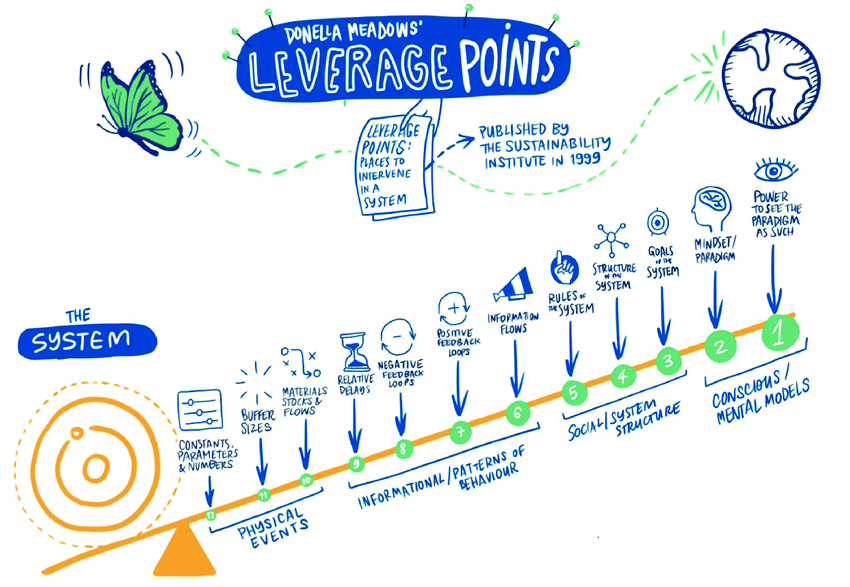
The idea is that to change the state of the system you need to impact one of those levers. Intervening at the bottom of the diagram (physical events) has little impact and can be potentially hard to do. Intervening at the top (mental models) has huge impact.
This particular diagram isn’t quite right for design contexts but it gives a good idea. We need to find leverage points worth investing in and stop spending time on things that don’t make impact. ROI comes to mind. It lives squarely in the “constants, parameters & numbers” bucket. I once spend a tremendous amount of effort trying to prove the ROI of research. It has an impact of sorts and I was successful. How much more impact would I have achieved had I invested time in changing mindsets and mental models though.
It’s an interesting area to explore. Design as a system. What are our leverage points? What are the actors within the organisational ecosystem we could influence? Where are the information flows and positive feedback loops?