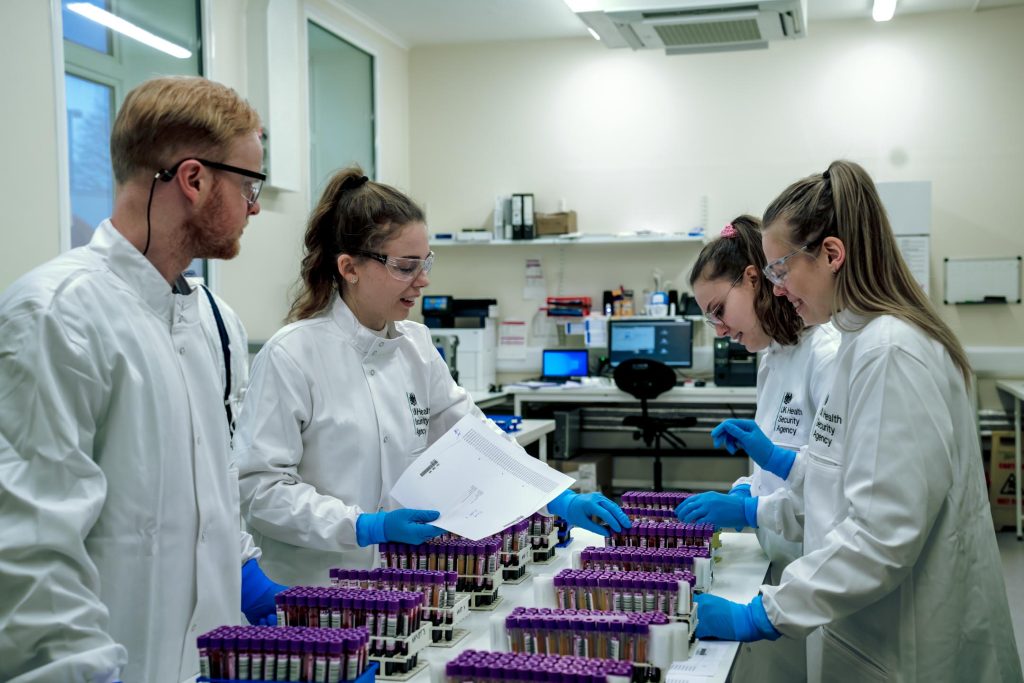
We worked with the UK Health Security Agency to identify opportunities to improve the Measles Surveillance Pathway. Navigating internal politics and ethical considerations, I led a team to plan and conduct a Discovery. We identified £800k in estimated efficiency savings through automation and process improvement.
I stood up a team to lead a Discovery phase into the Measles Surveillance Pathway at UK Health Security Agency (HSA). Navigating complex organisational and policy landscape our team successfully interviewed 35 Health Protection Team (HPT) members. We produced 75+ insights, 4 user archetypes, fed into a creation of the “to-be” service blueprint.
Situation
Measles Surveillance is a complex pathway where multiple teams must work together to produce accurate data about the measles cases in the UK. For this the Health Security Agency, responsible for all health related threats to the UK security, created the current “pathway”. It is supported by multiple regional Health Protection Teams, responsible for day to day health of their respective regions.
When a measles case is suspected (by a doctor, or a school nurse, or another healthcare practitioner) a report is made to the local HPT. The local HPT investigates, conduct any necessary follow ups (usually in the form of an oral kit sent to the patient), and send the samples off to a lab. If a measles case is confirmed necessary interventions are made.
Task
Our team was brought to conduct generative research with HPTs to understand their pain points and needs, and to identify opportunities to increase efficiency and oral fluid kit (OFK) return rates.
Approach
We opted for in-depth interviews as the most pragmatic approach. Surveys, contextual inquiries, and focus groups were considered but rejected due to time, budget, or organisational constraints.
There were several challenges the team had overcome while working in this regulation heavy environment with low UX-maturity.
1. Organisational resistance
Due to the decentralised nature of the regional HPTs it wasn’t immediately obvious who to contact about recruiting participants for our interviews; additionally there seemed to be negative sentiment from the HPTs about the governing HSA; a relatively new department that came to replace the old Public Health England.
To avoid further delays we went to the source. We contacted HPT team leads directly and asked them to attend an introduction meeting with us. During this meeting we explained the nature of the research and what we were trying to achieve.
While the immediate resistance was overcome, and we got our recruitment emails out to the teams, the negative sentiment remained throughout. We navigated this by making our intentions and the nature of our research clear upfront in the information sheets we produced.
Relevant skills: managing consent, stakeholder management, relationship building, influencing, advocating for research.
2. Stakeholder resistance
Our first draft of the plan was met with scepticism. Stakeholders from clinical and academic backgrounds felt our epistemology was lacking and our approach was not robust enough to give the insights any confidence or weight. These stakeholders were initially not available for conversation and it took some time before we got everyone in the room together.
During our conversation I had a chance to educated them about UX research and how it’s different. How the scope and the objective of the research differs from academic or clinical research, for example. I steered the conversation away from NHS Ethics Board Reviews and more towards collaborative workshops and solving a challenge together. This was successful in getting buy-in and unblocking our path forward.
Relevant skills: advocating for research, stakeholder management.
3. Data protection concerns
No Data Protection Impact Assessment was conducted prior to the research team coming onboard. This delayed us significantly. However, I worked with the senior leadership and Quality, Risk, Mitigation (QRM) colleagues to get a Data Protection Agreement (DPA) in place.
Relevant skills: data protection regulations.
Result
As a result of my advocacy and strong stakeholder management skills we conducted 35 interviews with HPT members. Participants, once they understood what we were trying to achieve, were helpful and open, providing rich insight into their daily lives, frustrations, and needs. The final report, containing 4 personas, 9 efficiency saving concept designs, and 1 “to-be” service blueprint, was well received by the client and was used to plan an Alpha phase in the future.